
How to Spot High Quality Clothing: 7 Signs to Check
Table of Contents
- What You'll Need Before You Shop
- How to Check Fabric Quality: The Touch Test and Beyond
- Signs of Well-Made Clothing: Seams, Stitching, and Hardware
- How to Spot High Quality Clothing Online
- How to Refresh Delicate Dresses Without Washing
- Cost-Per-Wear: The Math That Beats Fast Fashion
- How to Spot High Quality Clothing in Second-Hand and Vintage Pieces
- Conclusion
- Frequently Asked Questions
Last Updated: September 18, 2026
What You'll Need Before You Shop
You don't need a fashion degree to tell well-made clothing from the disposable kind, just ten minutes, decent lighting, and a short list of checks in a specific order.
High quality clothing is a garment whose fabric, construction, and hardware hold up to repeated wear and washing without losing shape, color, or structural integrity. That definition matters because the market is working against you: the fast fashion sector reached a valuation of $150.82 billion in 2026, up 10.74% from 2024, according to Uniform Market's fast fashion statistics.
Before you shop, bring these four things:
- Good overhead lighting. Dressing room fluorescents hide thin, loosely woven fabric; daylight or a phone flashlight reveals it.
- A phone camera. Zoom into seams and hardware to catch flaws your eye skips.
- The care label, read first. Fiber content and care instructions tell you more about longevity than the price tag does.
- A cost-per-wear mindset. A $128 dress worn 40 times costs $3.20 per wear; a $25 dress worn twice costs $12.50.
How to Check Fabric Quality: The Touch Test and Beyond
The fastest way to check fabric quality is the Touch Test: pinch the fabric between thumb and fingers, then release. Quality fabric springs back with body and slight resistance. Cheap fabric collapses flat or feels slick and papery.
Here's what your hands are detecting:
- Hand-feel signals fiber type before you read a label. Natural fibers like cotton and linen feel cool and slightly textured; synthetics feel smooth but plastic-like.
- Fabric density shows up as weight and opacity. Hold the garment to light, if you see your hand clearly through it, the weave is loose and will pill and snag fast.
- GSM (grams per square meter) measures that density. Heavier knits hold shape longer; anything under roughly 150 GSM in a t-shirt or dress will go sheer and sag.
- Breathability matters for daily wear. Tightly woven synthetics trap heat; natural fibers move air.
Signs of Well-Made Clothing: Seams, Stitching, and Hardware
Well-made clothing shows dense, even stitching with no loose threads, seams that lie flat without puckering, and hardware that feels solid rather than hollow. Flip the garment inside out. That's where the truth lives.
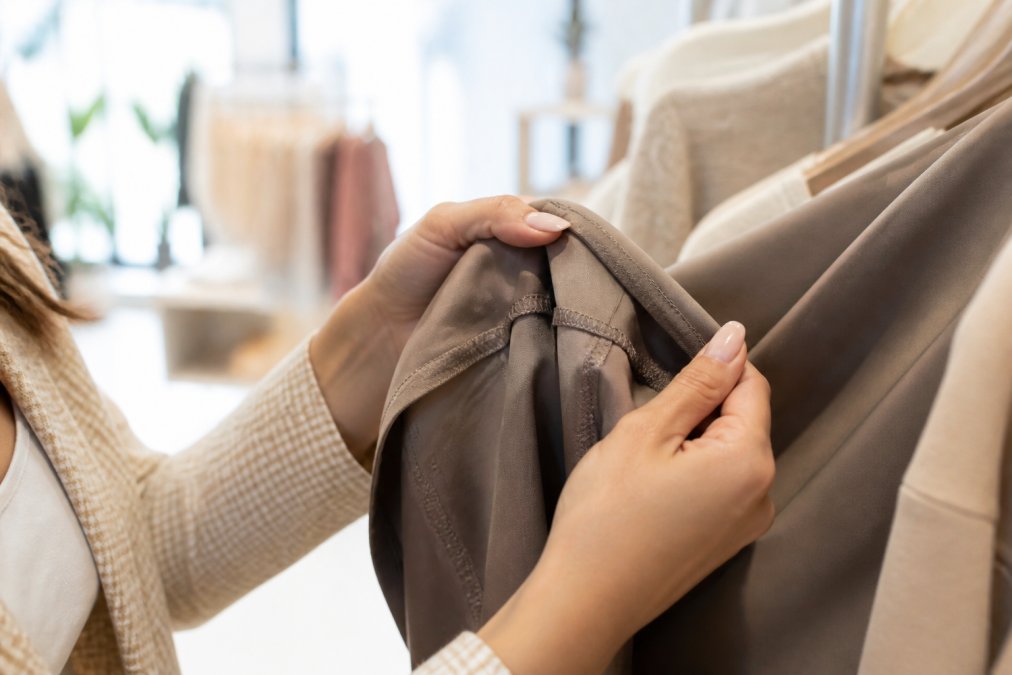
Check these in order:
- Stitch count and tension. Run your finger along an inner seam. Even, tight stitches with no gaps mean good tension; skipped stitches or wavy lines mean the machine was rushed.
- Seam allowance and hem finishing. A generous seam allowance lets a garment be let out later. Narrow, fraying edges with no overlock or binding will unravel within a few washes.
- Pattern matching. On prints, stripes, and plaids, the pattern should align across the side seams, center front, and pocket joins. A mismatched stripe at the shoulder is a shortcut, not a style choice.
- Buttonholes and buttons. Buttonholes should be densely stitched with no loose threads at the corners; reinforcement separates a blouse that lasts from one that gapes. Buttons should be sewn with a shank so the fabric doesn't bunch when fastened.
- Hardware durability. Zippers should glide without catching, and metal snaps and hooks should feel weighty. Hollow, tinny hardware bends and pops off.
- Structural details. Plackets, yokes, interfacing at collars, and linings add shape and longevity. A lined garment drapes better and hides seam allowances.
How to Spot High Quality Clothing Online
- GSM is your substitute for weight. A cotton t-shirt under roughly 150 GSM will go sheer and sag; a heavyweight tee in the 180-220 GSM range holds its shape. If GSM isn't listed, look for "heavyweight," "midweight," or "lightweight", and treat the absence of any weight descriptor as a yellow flag.
- Fiber content with percentages. "100% cotton" tells you everything; "cotton blend" tells you nothing. A percentage breakdown predicts hand-feel before it arrives: high cotton or linen reads cool and textured, high polyester reads slick and plastic-like, and a small elastane percentage (often 2-5%) explains stretch without turning the garment into a synthetic.
- Zoom on the seams. Look for puckering, loose threads, or mismatched patterns. A listing that never shows a seam close-up is hiding the one detail that predicts longevity.
- Real customer photos and reviews. If a boutique shows only studio shots, you're trusting the seller's lighting, not the garment. Search reviews for "pilled," "shrank," and "seam", that's where durability problems surface.
- Care instructions. Dry-clean-only isn't necessarily better made; it just costs more to own. Cold-water, lay-flat care is a sign the maker expects the piece to survive real wear.
- Return policy. A brand confident in its sizing and quality makes returns straightforward. A restrictive policy on a high-priced item is a mismatch worth noticing.
At Maison Amara Boutique, every listing shows fiber content and care details up front, and orders over $50 ship free, so you can test a piece without paying to find out.
How to Refresh Delicate Dresses Without Washing
Steaming is the safest way to refresh a delicate dress between washes. Hang it in a bathroom with the shower running hot, or use a handheld steamer, and most wrinkles and odors lift without water or agitation.
How to refresh a delicate dress without washing:
- Steam, don't iron. Hold a steamer several inches from the fabric and let the steam relax the fibers. Direct iron contact can scorch delicate weaves or melt synthetics.
- Spot-clean stains immediately. Dab with a damp cloth and a drop of mild detergent. Waiting lets stains set.
- Air it out. Hang the dress somewhere with airflow for a few hours after wearing. Most odors are surface-level and dissipate.
- Freeze for odor. For stubborn smells on unwashed pieces, seal the garment in a bag and freeze it overnight. This handles bacteria, not stains.
- Rotate your wardrobe. Wearing the same dress twice a week wears it out twice as fast. Rotation gives fibers time to recover.
Cost-Per-Wear: The Math That Beats Fast Fashion
Cost-per-wear is the purchase price divided by the number of times you actually wear the garment. It's the single most useful number for judging whether a piece is worth buying.
Fashioned Beveled-Edge Sunglasses →
The formula:
Cost-per-wear = Purchase price ÷ Number of wears
Run it on two dresses:
| Dress | Price | Wears Before It Fails | Cost-Per-Wear |
|---|---|---|---|
| Fast fashion dress | $25 | 2 wears | $12.50 |
| Well-made dress | $128.70 | 40 wears | $3.22 |
| Well-made dress (long-term) | $128.70 | 100 wears | $1.29 |
How to Spot High Quality Clothing in Second-Hand and Vintage Pieces
Second-hand and vintage pieces reward the same inspection as new garments, plus one extra check: fabric condition. Look for thinning, faded dye, and stretched elastic, which signal a garment near the end of its life.
What to inspect on second-hand pieces:
- Underarm and collar areas. These show the most wear. Thinning fabric or yellowed staining is hard to reverse.
- Elastic. Stretched or crackly waistband and cuff elastic means a repair before you can wear it. Replacing waistband elastic is a common, inexpensive fix; replacing elastic through a lined cuff is not.
- Seam integrity. Hold the garment up to light and check for pulled or split seams. A split seam on a wide-allowance vintage piece is often repairable; a frayed edge on a narrow modern seam usually isn't.
- Pilling. Surface pills on wool and knits indicate fiber damage, not just cosmetic wear. A pill shaver can reset the surface, but thin fabric underneath means structural damage.
- Smell. Musty odors often mean stored damp, which can lead to hidden mildew damage. Mildew staining on natural fibers is generally permanent.
- Lining and interfacing. On tailored vintage pieces, check whether the lining has separated from the shell and whether collar interfacing has bubbled. Both are fixable by a tailor, but factor the cost into your offer.
Conclusion
The difference between a wardrobe that lasts and one that cycles through the donation bin comes down to ten minutes of inspection per garment. Check the fabric first, then the seams, then the hardware. Do the cost-per-wear math before you buy, not after.
Shop now and start building a wardrobe that lasts.
Frequently Asked Questions
What are the signs of high-quality garment construction?
Check seams for tight, even stitching with no loose threads. Look for pattern matching at seams, reinforced buttonholes, and quality hardware like metal zippers. Fabric should feel substantial, not thin or scratchy. Inside finishing matters too: clean serging, no raw edges, and interfacing that holds its shape. These signs of well-made clothing separate garments that last from those that fall apart after a few washes.
Is 100% cotton or a 50/50 blend better for quality?
Neither is automatically better. According to the 2026 Global Lifestyle Monitor survey, 59% of consumers rate cotton clothing as having the best quality, and 100% cotton offers breathability and natural hand-feel. But a 50/50 blend can add durability and reduce shrinkage. The right choice depends on use: cotton for breathable everyday wear, blends for stretch and wrinkle resistance. Check fiber content labels and feel the fabric to decide.
How can you tell if a fabric will last after multiple washes?
Inspect fabric density and weave tightness. Hold the garment to light: if you can see through it easily, it may pill or tear quickly. Check for signs of premature wear like snags, peeling, or bubbling, which indicate low-grade materials. Read care instructions and fiber content. Natural fibers like cotton and linen generally hold up well, while cheap synthetics may lose shape. A garment that fails a wash cycle often reflects material and care, not just design.
What is cost-per-wear and why does it matter?
Cost-per-wear is the price divided by how many times you wear an item. A $20 dress worn twice costs $10 per wear. A $100 dress worn 50 times costs $2 per wear. This math shows why high quality clothing often costs less over time, even at a higher upfront price. Fast fashion items may seem cheap but fall apart quickly, raising their cost-per-wear. Budget-aware shoppers should calculate this before buying.