
Versatile Clothing Staples for a Professional Capsule
Table of Contents
- What Belongs in a Professional Capsule (Versatile Clothing Staples)
- How to Build a Capsule Wardrobe for Work: A Step-by-Step Framework
- Business Casual Capsule Wardrobe: Dress Codes, Fit, and Sizing
- Work Capsule Wardrobe Outfit Ideas: 9 Formulas That Mix and Match
- Budget Tiers and Cost-Per-Wear for a Work Capsule Wardrobe
- Fabric Care, Durability, and Seasonality: Making the Capsule Last
- Conclusion
- Frequently Asked Questions
Last Updated: October 13, 2026
What Belongs in a Professional Capsule (Versatile Clothing Staples)
A professional capsule is a small, curated set of versatile clothing staples that mix and match into dozens of polished work outfits. At Maison Amara Boutique, we build capsules around pieces that carry you from Monday meetings to Friday drinks without a wasted hanger.
The formula is simple: neutrals do the heavy lifting, and a few statement pieces keep things interesting. According to The Capsulist's 2026 work capsule guide, a tailored blazer, tailored trousers, a white button-down shirt, black loafers, and a structured work bag form the backbone of a modern work capsule. Vogue's capsule wardrobe guidance points to V-necks, cardigans, and neutral turtlenecks as the most versatile layering pieces you can own.
Below, we break down which staples belong in your professional capsule, how many pieces you need, and how to stretch them across a full workweek.
The 15-Piece Core: Tops, Trousers, and Layering Pieces
Fifteen pieces sounds stingy until you do the math. Three bottoms, five tops, three layering pieces, two pairs of shoes, and two bags produce well over a month of distinct outfits.
Start with tops. A white button-down and a silk blouse handle formal days; a knit pullover and a cardigan cover everything in between.
For bottoms, one pair of tailored trousers, one mid-length skirt, and one dark straight-leg jean cover nearly every dress code.
How Many Pieces Should a Work Capsule Wardrobe Have?
Most work capsule wardrobes land between 15 and 40 pieces. A hybrid schedule needs closer to 15; a five-day office week justifies 30 to 40.
The Wardrobe Consultant built 15 professional work outfits, roughly three workweeks, from a single corporate capsule foundation.
If you're building from scratch, start at the low end and add as gaps appear. Buying 40 pieces upfront usually means owning 15 you never wear.
How to Build a Capsule Wardrobe for Work: A Step-by-Step Framework
Building a work capsule takes about two hours of planning and one shopping session. Order matters more than budget.
- Audit your current closet. Pull everything you wore to work in the last month. Set aside anything that doesn't fit or needs repair.
- Identify your dress code. Note whether your office runs business formal, business casual, or smart casual. This decides your fabric and silhouette choices.
- Choose a neutral base. Pick two neutrals (black and navy, or gray and camel) and build around them.
- Fill the gaps by function. You need tops, bottoms, layers, shoes, and outerwear. Buy one of each before doubling up.
- Test 10 outfit combinations. If a new piece can't form three outfits with what you own, return it.
- Rotate, don't hoard. Wear each piece at least once every two weeks or cut it from the capsule.
Business Casual Capsule Wardrobe: Dress Codes, Fit, and Sizing
A business casual capsule wardrobe sits between formal suiting and weekend wear: tailored separates, clean lines, no athleisure. Staples stay the same across dress codes; fabric and fit change.
Matching the Capsule to Your Workplace Dress Code
| Dress Code | Bottoms | Tops | Layers | Shoes |
|---|---|---|---|---|
| Business formal | Tailored trousers, mid-length skirt | Button-down, silk blouse | Structured blazer | Pumps, loafers |
| Business casual | Trousers, dark straight jeans | Knit top, blouse | Cardigan, vest | Loafers, low heel |
| Smart casual | Jeans, mid-length skirt | Sweater, statement top | Open cardigan | Clean sneakers, boots |
| Remote or hybrid | Jeans, relaxed trousers | Knit pullover | Cardigan | Comfortable flats |
Fit, Sizing, and Inclusive Wardrobe Planning
Fit is where most capsules fail: pieces that don't fit properly produce nothing but frustration.
Buy for your largest measurement and tailor down. Trousers and blazers are easy to take in, nearly impossible to let out. Look for brands with detailed size charts and extended sizing, like our Women's Fashion Cable Knit Cardigan, which runs from Small to 3XL.
Work Capsule Wardrobe Outfit Ideas: 9 Formulas That Mix and Match
These nine formulas cover every workday scenario, from board presentations to casual Fridays, using only pieces from the 15-piece core.
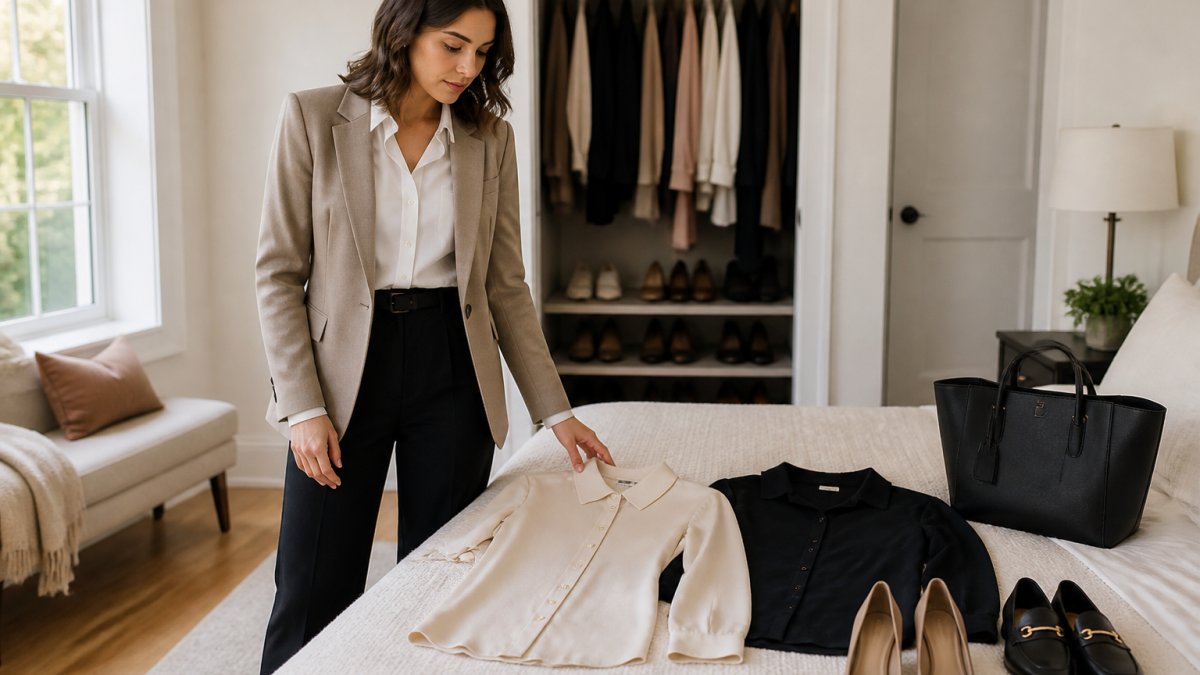
- The presentation: Blazer + button-down + tailored trousers + loafers
- The client lunch: Silk blouse + mid-length skirt + pumps
- The casual Friday: Knit pullover + dark jeans + clean sneakers
- The long meeting day: Cardigan + blouse + relaxed trousers + flats
- The after-work drinks: Statement top + straight jeans + heeled boots
- The travel day: Turtleneck + straight jeans + cardigan + comfortable flats
- The video call: Blouse + cardigan (waist-up polish, comfort below)
- The interview: Blazer + button-down + tailored trousers + structured bag
- The hybrid Monday: Sweater + mid-length skirt + loafers
The Confident Striped Knit Pullover Sweater pairs with high-waisted denim and ankle boots for formula five; the Winnie Turtleneck Sweater anchors formula six on travel days.
Budget Tiers and Cost-Per-Wear for a Work Capsule Wardrobe
Cost-per-wear (CPW) is the only number that matters when building a capsule: purchase price divided by the number of times you actually wear the piece. A $20 blouse worn twice costs $10 per wear; a $70 sweater worn weekly for a year costs about $1.35 per wear.
Run the math before you buy. Shoppers often justify a cheap purchase with "it was only $20" and never wear it, while the piece they hesitated over becomes the workhorse.
Three Budget Tiers, Built in Order
Don't buy the whole capsule at once. Build it in tiers, one paycheck at a time, and let each tier prove itself before moving on.
- Starter tier (core five): One blazer, one pair of tailored trousers, one button-down, one pair of loafers, one structured bag. These five pieces form the backbone of every formal and business-casual outfit. Buy them first, even if it takes two months.
- Mid tier (layers and rotation): Add a cardigan, a knit pullover, a second pair of shoes, and a mid-length skirt. This is where your outfit count jumps from roughly 10 combinations to 30 or more.
- Full capsule (15 pieces): Fill in the statement top, the dark straight-leg jean, the turtleneck, and a second bag. At this point you should be able to go three full workweeks without repeating an outfit.
How to Prioritize When the Budget Is Tight
Rank every purchase by three questions:
Paige Eyelet Embroidered Puff Sleeve Blouse →
- How many existing pieces does it combine with? If the answer is fewer than three, skip it for now.
- How many wears per month will it get? A piece you'll wear eight times a month beats a piece you'll wear twice, even at the same price.
- Does it fill a function gap or duplicate one? A second blazer is a duplicate until you've worn out the first.
Our Elia Cuffed Straight Loose Jeans at $37.39 and the Textured Pullover Sweater at $25.74 both land in the starter tier and each pairs with at least four other core pieces. Free shipping on orders of $50 and more means two core pieces often qualify in a single order, keeping the per-piece effective cost lower.
The 30-Wear Rule
Before any purchase above the starter tier, ask whether you'll wear the piece at least 30 times in the next year, roughly once every 12 days. If you can't picture 30 specific occasions, it doesn't belong in the capsule yet.
Fabric Care, Durability, and Seasonality: Making the Capsule Last
Capsule pieces earn their keep through repeated wear, so fabric performance decides whether your investment lasts two seasons or ten, and whether your cost-per-wear math holds up.
How to Read a Fabric Label Before You Buy
Natural fibers like cotton, wool, and linen generally hold up better under repeated wear than high-synthetic blends, though a small amount of stretch (typically 2-5% elastane) helps trousers and blazers keep their shape without sagging.
A quick framework for judging durability:
- High durability: 100% wool suiting, heavyweight cotton poplin, linen blends with a tight weave. These resist pilling and hold structure through dozens of wears.
- Medium durability: Cotton-synthetic blends, fine-gauge knits, silk. These look polished but need gentler handling and may pill or snag over time.
- Lower durability: Thin synthetic knits, loose-weave fabrics, anything with visible loose fibers. These tend to stretch out, pill, or lose shape within a season of regular wear.
When you're choosing between two similar pieces, the fabric label is often a better predictor of long-term value than the price tag.
Care Instructions That Actually Extend Life
Follow the care label, but a few rules apply to nearly every capsule piece:
- Wash less often than you think. Wool and cotton suiting can often go three to five wears between washes if aired out overnight. Overwashing is the single fastest way to break down fibers.
- Cold water, gentle cycle, or hand wash. Heat is what shrinks wool and fades dark neutrals. Cold water preserves both color and fit.
- Flat dry knits, hang dry wovens. Hanging a wet knit stretches the shoulders and hem. Laying it flat on a towel preserves the shape.
The Confident Striped Knit Pullover Sweater calls for cold hand washing or a delicate cycle, no bleach, and flat drying away from direct sunlight. Treat every knit in your capsule the same way.
Seasonality: Building a Year-Round Rotation
A capsule that only works in one season isn't versatile. The fix is a rotation system, not a single fixed set.
Keep a core layer of pieces that work year-round: button-downs, tailored trousers, loafers, a structured blazer. Then maintain a seasonal layer you swap in and out:
- Warm months: Linen or lightweight cotton tops, unlined blazers, open cardigans, breathable flats.
- Cool months: Merino or cashmere turtlenecks, heavier wool blazers, closed-toe boots, thicker knit cardigans.
- Transitional weeks: Keep two mid-weight layers in the active capsule at all times, such as a cardigan and a knit pullover, so you can adjust to temperature swings without rebuilding the whole rotation.
In a climate-controlled office, a turtleneck and a cardigan cover most of the year; the seasonal swap is mostly about your commute and outdoor time, not the desk.
Conclusion
Building a professional capsule takes discipline, not a big budget. The hardest part is resisting one more "just in case" piece when your core 15 already covers every workday scenario.
That's where Maison Amara Boutique helps. Our collection pairs timeless staples with contemporary details, from embroidered blouses to cable knit cardigans, so every piece earns its place in your rotation.
Shop now and build a work wardrobe that works as hard as you do.
Frequently Asked Questions
What's included in a capsule wardrobe for work?
A work capsule typically centers on a small set of interchangeable pieces: two or three blazers or cardigans, four to six tops (button-downs, blouses, knits), two or three pairs of trousers or skirts, one suit, and one or two pairs of work shoes. The Capsulist's 2026 work-capsule guide lists a tailored blazer, tailored trousers, a white button-down shirt, black loafers, and a structured work bag as core pieces. The goal is that every item pairs with at least three others, so a professional capsule produces weeks of outfits from a single drawer.
How many pieces should be in a work capsule wardrobe?
Most working capsules land between 15 and 40 pieces, depending on how often you do laundry and whether you work in person five days a week or two. A tight 15-piece core covers roughly three workweeks of outfits, which is exactly what The Wardrobe Consultant reported building from a 22-piece corporate capsule foundation: 15 different professional outfits. Start at the low end, track which pieces you actually reach for, and add only what fills a real gap rather than what looks good on a hanger.
What are the best basics for a business casual capsule wardrobe?
Neutral bottoms, one structured layer, and tops that layer cleanly. Vogue names V-necks, cardigans, and neutral-colored turtlenecks as versatile capsule pieces, and those work as the base for business casual and smart casual offices alike. Add a white collared shirt or button-down, a silk blouse or statement top for client days, and a mid-length skirt or tailored trousers. Jewel tones and elevated essentials in solid colors stretch further than prints, because they coordinate with everything else in the rotation.
How can you make a small work wardrobe feel versatile?
Change the layer, not the base. Keep bottoms and tops in a tight color family, then rotate blazers, vests, and cardigans over the same trousers to create distinct outfits. A single white button-down can sit under a blazer for a client meeting, under a cardigan for a normal office day, or open over a layering tank for a smart casual Friday. Accessories do the rest: a structured work bag, a belt, and one piece of jewelry shift the same outfit from 9-to-5 to after-work drinks.
How do I budget for a professional capsule without overspending?
Buy the pieces you wear most often first, and judge them by cost-per-wear rather than sticker price. A $70 sweater worn twice a week for a season costs far less per wear than a $30 top that pills after three washes. Spread purchases across two or three months, prioritize bottoms and layers since they carry the most outfits, and watch for free shipping thresholds so small orders do not eat your budget. Maison Amara Boutique offers free shipping on orders of $50 and more, which makes filling a capsule gap in one order more economical.