
How to Style Business Casual Outfits on a Budget in 2026
Table of Contents
- What You'll Need Before You Start Styling
- Build a Capsule Wardrobe for Work That Stretches Every Dollar
- Your Business Casual Essentials List for 2026
- How to Mix and Match Business Casual Outfits Without Repeating
- Where Affordable Trendy Dresses for Women Fit Into Office Style
- Budget Shopping Strategies That Protect Garment Quality
- Sustainable and Ethical Budget Shopping Habits
- Common Mistakes to Avoid When Styling Business Casual on a Budget
- Frequently Asked Questions
Last Updated: September 20, 2026
What You'll Need Before You Start Styling
You do not need a big budget to look polished at work. You need a plan, a color scheme, and a short list of pieces that work together. This guide from Maison Amara Boutique shows you how to style business casual outfits on a budget without buying a whole new closet.
Start with these three things:
- A color palette. Pick two neutrals (navy, charcoal, black, or beige) plus one accent.
- A body measurement card. Note your bust, waist, hip, and inseam in inches.
- A budget cap. Decide your monthly spend before you shop, not after.
Build a Capsule Wardrobe for Work That Stretches Every Dollar
A capsule wardrobe for work is a small set of pieces that mix together to create many outfits. The goal is fewer items, more combinations, and a lower cost per wear.
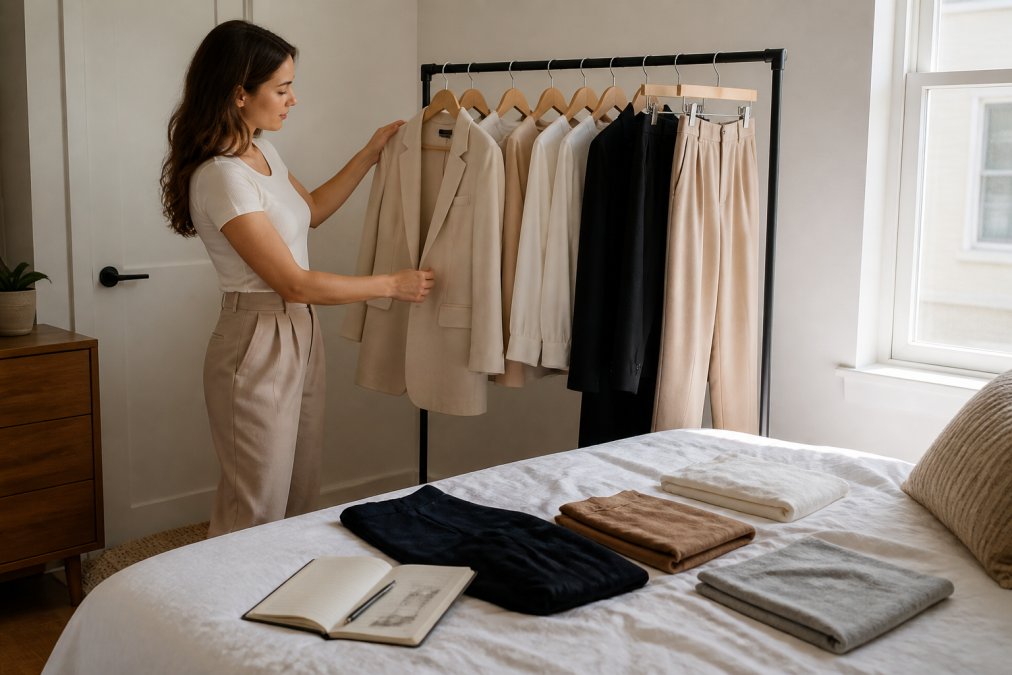
The 15-Piece Formula for a Two-Week Rotation
Use this breakdown as your starting point:
| Category | Pieces | Examples |
|---|---|---|
| Bottoms | 4 | Wide-leg trousers, straight jeans, midi skirt, chinos |
| Tops | 5 | Blouse, button-down, knit polo, ruffled shirt, tee |
| Layers | 3 | Fitted blazer, cardigan, open-front jacket |
| Dresses | 2 | Midi dress, wrap dress |
| Shoes | 1 | Neutral flat or low heel |
Fifteen pieces, ten workdays, dozens of combinations. That is the math that makes a capsule pay off.
Your Business Casual Essentials List for 2026
A solid business casual essentials list covers four areas: tops, bottoms, layers, and shoes. Get those right and you can dress for almost any office.
Tops, Bottoms, and the One Layer That Changes Everything
Tops. A blouse is the workhorse. The Fashion Lantern Sleeve Button Splicing Shirt is a good example at $25.20. The Keyla Ruffled Short Sleeve Shirt works the same way at $28.59.

Read the Fabric Tag Before You Read the Price Tag
Two tops at the same price are not the same purchase. Fabric content decides how a garment drapes, how it washes, and how long it survives a weekly rotation.
- Cotton and cotton blends breathe well and hold a press. Look for at least 60% cotton in button-downs; a small amount of elastane (2-5%) adds stretch without sagging.
- Viscose and rayon drape like silk at a fraction of the cost, but they pill and shrink faster. Treat them as two-to-three-season pieces, not decade pieces.
- Polyester is durable and wrinkle-resistant, which is why it dominates budget workwear. Blended with cotton or viscose, it resists creasing; worn alone, it can look shiny under office lighting.
- Wool blends in suiting hold shape and resist odor, but they need dry cleaning. A 50/50 wool-poly blend is the usual budget compromise.
Fit Beats Brand Every Time
A $25 blouse that fits your shoulders correctly looks more expensive than a $90 blouse that pulls across the chest. Three fit checkpoints matter most:
- Shoulder seam. It should sit at the edge of your shoulder bone, not past it. This is the one alteration that is rarely worth paying for, if the shoulders are wrong, skip the piece.
- Sleeve length. For a blazer, the sleeve should end at the wrist bone so a half-inch of shirt cuff shows.
- Waist and hem. A hem that hits at the hip bone reads intentional; one that hits mid-hip reads borrowed.
The Cost-Per-Outfit Test
Before any piece earns a spot in your capsule, run it through one question: how many distinct outfits can I build with this and what I already own? A neutral blazer that works over five tops and three bottoms is worth three times a trendy top that works with one. That math, not the sticker price, is what keeps a budget wardrobe from ballooning.
How to Mix and Match Business Casual Outfits Without Repeating
Mixing and matching comes down to a simple rule: keep colors neutral, then swap one piece at a time. A white blouse with navy trousers on Monday becomes the same blouse with a midi skirt on Tuesday.
Try this rotation:
- Pair each bottom with two different tops.
- Add a layer to one of those combos.
- Swap shoes to shift the outfit from day to evening.
- Repeat the set with a new bottom.
Where Affordable Trendy Dresses for Women Fit Into Office Style
Affordable trendy dresses for women solve the hardest problem in a work wardrobe: getting dressed in under two minutes. A midi dress needs no matching. Add a blazer, and you are done.
Budget Shopping Strategies That Protect Garment Quality
Cheap does not have to mean flimsy. The trick is knowing where to spend, where to save, and which channels actually deliver quality at a low price.
Cost-Per-Wear Math, Done Properly
Cost-per-wear is the price of an item divided by how many times you wear it.
- A $39 blazer worn 40 times costs about $1 per wear.
- A $15 top worn twice costs $7.50 per wear.
Where to Shop, Channel by Channel
Each channel has a different trade-off between price, quality, and time.
- Thrift and consignment stores. Best for blazers, trousers, and leather shoes, categories where older construction often beats new budget construction. Inspect the underarm seams, the lining, and the sole wear. A $12 wool blazer with a worn lining is still a bargain if the shell is intact.
- Online resale platforms. Good for specific brands and sizes you already know fit. Filter by "new with tags" to skip the wear question, and always check the seller's measurements against your measurement card rather than the listed size.
- Off-price retailers. Inventory rotates, so go with a list and a color palette. The risk is buying a deal because it is a deal, not because it fits your capsule.
- End-of-season sales. Buy next season's basics at the end of the current one. A neutral cardigan bought in spring costs less than the same cardigan bought in fall.
- Clothing swaps. Free, social, and the fastest way to refresh a rotation. Bring pieces that fit your old body or old job, not pieces you are emotionally attached to.
The Pre-Purchase Checklist
Run every candidate through this before it goes in the cart:
- Can I name three outfits this works with?
- Is the fabric thick enough to hold its shape?
- Are the seams straight and the buttons secure?
- Does it fit today, not after I lose five pounds?
- Will I wear it at least 20 times this year?
- Does the care label match how I actually do laundry?
Sustainable and Ethical Budget Shopping Habits
Buying less is the most sustainable choice you can make. It also happens to be the cheapest.
Focus on four habits:
- Repair before you replace.
- Wash less often. Air out knits between wears to keep them in shape and reduce fiber breakdown.
- Store properly. Fold knits, hang blazers on wide shoulders, and keep denim out of direct sun to prevent fading.
- Choose fibers with a longer life. Natural fibers and dense blends generally outlast thin synthetics, which means fewer replacements and less waste over three years.
Sustainable and Ethical Budget Shopping Habits
Buying less is the most sustainable choice you can make. It also happens to be the cheapest.
Focus on three habits:
- Repair before you replace.
- Wash less often. Air out knits between wears to keep them in shape.
- Store properly. Fold knits, hang blazers, and keep denim out of direct sun.
Common Mistakes to Avoid When Styling Business Casual on a Budget
Most budget wardrobes fail for the same few reasons. Here is what to watch for.
Skipping tailoring.
Frequently Asked Questions
How can I dress business casual cheaply without looking underdressed?
Start with a small capsule of neutral pieces: one fitted blazer, two pairs of trousers or chinos, three tops, and one midi dress. When you are unsure about an office dress code, dress more formally and remove a layer if needed. This conservative approach works as a safety net. Mixing elevated basics like a white button-down with high-rise denim keeps the look polished without high cost.
What is the 3-3-3 rule for clothes and does it work for business casual?
The 3-3-3 rule means three tops, three bottoms, and three pairs of shoes, which creates nine outfit combinations. For business casual, you can expand it to include one blazer, one cardigan, and one midi dress. This formula helps you build a capsule wardrobe for work that covers a full week. It also makes cost-per-wear easy to track because every piece earns its place.
What should I avoid wearing for business casual at the office?
Avoid athletic shoes, graphic tees, shorts, and overly casual denim with rips or fading. Beachwear, spaghetti straps without a layer, and loud logos also read as too casual. If your workplace dress code leans formal, skip leggings as pants and flip-flops. When in doubt, add a structured layer like a blazer or cardigan to bring an outfit up to office-appropriate standards.
How do I build a professional wardrobe with limited funds?
Shop thrift stores and clothing swaps first, then fill gaps with budget-friendly retailers. Focus on elevated basics in a neutral color palette: white, pale blue, navy, charcoal, and black. Track cost-per-wear by dividing the price by how many times you wear an item. Pieces under $40 that you wear 30 times cost about $1.30 per wear, which beats a $120 item worn twice.
Building a work wardrobe on a budget takes patience, but the payoff lasts for years. The hardest part is finding pieces that look polished and still feel current. That is the gap Maison Amara Boutique was built to fill, with trendy women's clothing, stylish dresses and accessories, and free shipping on orders of $50 or more. Start with one capsule, one color palette, and one good layer. Shop now with Maison Amara Boutique and build a work wardrobe that earns its place in your closet.