
How to Style Accessories for Work: 7 Rules
Table of Contents
- Assess Your Office Environment and Dress Code
- Minimalist Jewelry for Work: The Foundation of Professional Style
- Business Casual Accessory Rules: The Statement Piece Strategy
- Styling Belts for Work Dresses: Creating Definition and Proportion
- Professional Footwear and Leather Goods: The Grounding Elements
- Color Coordination and Neutral Palettes for a Polished Appearance
- Hair Accessories and Day-to-Night Transitions
- How to Style Accessories for Work Without Overdoing It
Last Updated: August 19, 2026
According to research from Ascots & Chapels' 2024 study on professional appearance, 78.6% of well-groomed professionals experience better career growth. Yet styling accessories for work remains one of the most overlooked elements of workplace wardrobing. The difference between looking polished and looking overdone often comes down to understanding proportion, restraint, and intentionality.
Learning how to style accessories for work doesn't require an expensive wardrobe overhaul or a personal stylist, it requires clarity about your office environment and a commitment to the principle that fewer, better pieces almost always win.
This guide covers the seven rules that separate a sophisticated professional appearance from one that misses the mark. Whether you're dressing for a corporate office, creative agency, or hybrid environment, these principles will help you build an accessories strategy that elevates your professional presence.
Assess Your Office Environment and Dress Code
Your accessories strategy starts with understanding the actual culture you're dressing for, not the one you imagine. A corporate law firm operates under entirely different unwritten rules than a tech startup, even if both claim "business casual." One values conservative restraint; the other celebrates individual expression.
Spend your first week observing what senior leaders and successful peers are actually wearing. Are women wearing visible jewelry? How much? What metals dominate? Are belts standard or rare? Do people wear statement bags or minimal ones?
Research from International Workplace Group's 2025 career advancement report found that 16% of employees believed they'd missed promotions partly because of attire choices. Dress code misalignment creates a credibility gap before you even speak.
Categorize your workplace into one of three buckets:
Conservative environments (law, finance, government, healthcare) demand minimal, classic accessories. Think structured leather goods, delicate metals, and one focal point maximum.
Creative environments (design, marketing, media, tech) typically welcome more personality and trend-forward pieces. Statement jewelry, bold belts, and distinctive bags signal cultural fit.
Hybrid/business casual environments (most mid-size companies today) split the difference. Professional but not formal, approachable but not casual.
Your accessories choices must align with this assessment. A statement ring perfect in a creative agency reads as unprofessional in a law office.
Minimalist Jewelry for Work: The Foundation of Professional Style
Minimalist jewelry for work isn't about owning less, it's about restraint in daily rotation. Jewelry should enhance your professional presence, not distract from it. According to research from Temple University's 2024 study on workplace performance, when workers wear clothes and accessories they feel genuinely good about, they perform better.
Dainty, understated pieces create a foundation of polish without noise. A delicate gold bracelet, small stud earrings, and a simple watch communicate sophistication more effectively than layered chains and multiple rings.
Start with these minimalist staples:
- One quality watch: Leather strap or simple metal band, classic face.
- Stud earrings: Gold, silver, or pearl. Small enough to go unnoticed, professional enough to always work.
- One delicate bracelet or bangle: Worn alone, not stacked.
- A simple ring: One ring maximum, typically on your right hand.
- Minimal necklace: If you wear one, keep it short (16-18 inches) and simple.
These pieces should fade into the background, allowing your competence and presence to be the focus.
Business Casual Accessory Rules: The Statement Piece Strategy
Business casual accessory rules help you navigate the ambiguity of a dress code that's neither formal nor casual. The most effective strategy centers on one principle: one statement piece, everything else minimal. This prevents visual chaos and keeps you looking intentional rather than overdone.
The One-Statement-Piece Rule
The one-statement-piece rule is perhaps the most important principle for how to style accessories for work. It means exactly what it sounds like: one accessory gets to be bold, interesting, or trend-forward. Everything else recedes.
A statement piece might be a structured leather belt, a bold watch, distinctive earrings, or a notable bag. Not all of these at once. Pick one. Make it count. Let everything else support it.
Your brain processes visual information hierarchically. Multiple competing focal points create cognitive load. A single, well-chosen statement piece creates clarity and says "I made a deliberate choice."
Consider this example: a woman wearing a simple black dress, minimal jewelry, a neutral bag, and a bold red belt is instantly more memorable and polished than the same woman wearing the same dress with a statement necklace, statement earrings, a patterned scarf, and a bold bag.


Choosing Between Dainty and Bold
Dainty jewelry (thin chains, small studs, delicate bracelets) works as your supporting cast. When you've chosen a bold statement piece, everything else should be dainty.
Bold jewelry (chunky bracelets, statement necklaces, large earrings) should be your one focal point. When you wear bold jewelry, your other pieces should disappear almost entirely.
The mistake most women make is mixing dainty and bold carelessly. A delicate watch paired with chunky bracelets and a statement necklace reads as indecisive. A bold watch paired with delicate earrings and a simple bracelet reads as intentional.
Styling Belts for Work Dresses: Creating Definition and Proportion
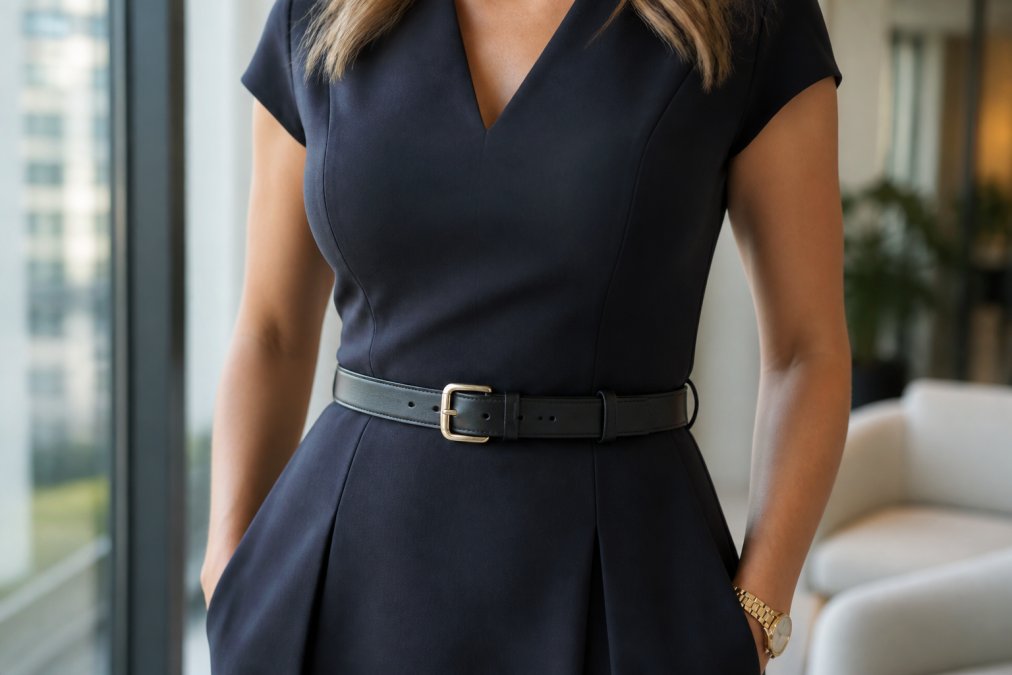
A belt does more than cinch your waist. It creates definition, breaks up long silhouettes, and signals intentionality about how you're dressing.
Wear a belt when your dress needs definition. A fitted sheath dress rarely needs one; it already has structure. A loose, flowing dress benefits enormously from one.
When you do wear a belt, follow these guidelines:
Width matters: A belt should be proportional to your frame. Petite frames generally benefit from narrower belts (1-1.5 inches). Average and larger frames can carry wider belts (1.5-2.5 inches).
Placement is everything: The belt should sit at your natural waist, not your hip. This creates the most flattering proportion and clearest definition.
Color coordination: A belt should either match your dress (monochromatic) or contrast intentionally. Avoid a random color.
Material signals formality: Leather belts read more professional than fabric. Structured leather in black, navy, or cognac works across most professional settings. The Women's Belts from BYMANYC ® New York collection at Maison Amara Boutique offers structured options designed specifically for this purpose, starting at $39.31.

Professional Footwear and Leather Goods: The Grounding Elements
Professional footwear and leather goods anchor your entire look. Worn shoes, scuffed heels, or overly trendy footwear can undermine an otherwise polished outfit. Well-maintained, classic shoes elevate even basic pieces.
The professional footwear hierarchy:
Tier 1 (most professional): Closed-toe pumps or flats in neutral colors. Black, navy, cognac, or gray. Heel height 1-3 inches.
Tier 2 (business casual appropriate): Loafers, minimal sneakers (white leather only), pointed-toe flats, or modest heels.
Tier 3 (creative/hybrid environments only): Boots, slightly more distinctive shoes, or trend-forward styles.
Avoid: Flip-flops, athletic shoes, overly embellished shoes, or weekend wear.
For leather goods, invest in quality. A structured leather bag in a neutral color works harder than five trendy bags. A $150 leather bag worn for three years costs less per wear than a $40 bag worn for six months.
Color Coordination and Neutral Palettes for a Polished Appearance
Your accessories should either disappear into a neutral palette or provide intentional contrast. There's no middle ground where a random color choice looks deliberate.
A neutral palette for professional accessories means: black, white, gray, navy, cognac, gold, silver, or rose gold. These colors work across seasons, outfits, and professional settings.
When you choose accessories, ask: does this color either match my outfit (creating harmony) or intentionally contrast (creating a focal point)? If neither, reconsider.
Matching your outfit (monochromatic): A black dress with black shoes and a black bag creates a lengthening, simplified effect.
Intentional contrast: A navy dress with cognac leather belt and shoes creates visual interest and breaks up the silhouette.
Accent through metals: Gold jewelry with silver accessories reads as careless. Choose one metal and stick with it.
Hair Accessories and Day-to-Night Transitions
Hair accessories for work often get overlooked, yet they significantly impact your overall polish. The rule is the same as jewelry: minimal and intentional. A simple hair clip, sleek headband, or small barrette in a neutral color works. Decorative clips, colorful elastics, or costume-like pieces undermine a professional appearance.
For most professional settings, the best hair accessory is no accessory at all, just well-maintained, styled hair. If you do use one, it should be nearly invisible, a tortoiseshell clip that blends with your hair color or a simple metal barrette.
Day-to-night transitions require a strategic accessory shift. You're not changing clothes, but you're signaling a context change through accessories.
At work: minimal jewelry, structured leather bag, professional shoes, simple watch.
Transitioning to evening: remove the watch, swap the structured bag for something smaller or more interesting, add a statement piece (bolder earrings, a necklace, or a ring). Keep shoes the same if possible.
This shift takes 30 seconds and transforms your presence from "working professional" to "off-duty."
How to Style Accessories for Work Without Overdoing It
The final rule ties everything together: restraint is more powerful than abundance.
When you're tempted to add more accessories, pause. Ask yourself: what is this piece adding? Is it supporting my statement piece, or competing with it? Does it enhance my professional presence, or distract from it?
Research from Northwestern University on enclothed cognition found that what people wear directly influences their psychological processes. Wearing accessories you feel genuinely good about matters. But wearing too many accessories, or ones that don't align with your workplace culture, creates cognitive dissonance.
The solution is a simple decision framework:
| Accessory Choice | Question to Ask | Action |
|---|---|---|
| Statement piece | Does this align with my workplace culture? | Keep it or swap it |
| Supporting piece | Does this compete with my statement piece? | Remove if yes |
| Metal choice | Does this match my other metals? | Swap if no |
| Color | Does this either match or intentionally contrast? | Swap if neither |
| Overall impression | Do I feel confident and professional? | If no, simplify |
Most women find that removing one piece, not adding one, creates the look they were after. Knowing what not to wear is more valuable than knowing what to wear.
Build your work accessories rotation around quality basics. The Niche Black Blazer from BYMANYC ® New York at Maison Amara Boutique ($71.50) pairs with minimal jewelry and a structured belt to create an instantly polished look. The Versatile Stand Collar Blazer, also from BYMANYC ® New York ($107.25) offers similar versatility with a modern silhouette.

The difference between looking professional and looking like you tried too hard often comes down to a single decision: choosing restraint. When you understand your workplace culture, commit to the one-statement-piece rule, and build your accessories rotation around quality neutral pieces, styling for work becomes automatic.
At Maison Amara Boutique, we understand that professional women need accessories that work harder, pieces that transition from office to evening, that pair with multiple outfits, and that signal intention rather than trend-chasing. Shop our curated collection of blazers, belts, and professional essentials, and enjoy free shipping on orders of $50 and more.
Frequently Asked Questions
What is the one-statement-piece rule for work accessories?
The one-statement-piece rule means selecting only one bold or eye-catching accessory per outfit, such as a chunky necklace, structured belt, or colored scarf, while keeping everything else minimal and neutral. This approach prevents your look from feeling cluttered and ensures your statement piece actually commands attention rather than competing with other bold elements. Research shows that individuals in professional attire are viewed as more intelligent and influential, and restraint in accessorizing reinforces that perception.
How should I choose between dainty and bold minimalist jewelry for work?
Dainty jewelry works best for conservative corporate environments where subtlety is valued, think delicate chains, small studs, or thin bracelets that complement without drawing focus. Bold minimalist pieces suit creative industries or business casual settings where personality shines through. Consider your office culture: if most colleagues wear simple jewelry, follow suit. If your workplace embraces individuality, a single bold piece signals confidence. According to research, customers are 25% more likely to trust a well-dressed professional, making intentional jewelry choices part of that trust-building equation.
What's the best way to style belts for work dresses?
Position your belt at the natural waist to create definition and elongate your silhouette, this is especially effective for A-line or shift dresses. Choose belts in neutral tones (black, brown, navy, tan) that coordinate with your dress and shoes rather than competing for attention. A structured leather belt from Maison Amara Boutique's HUDSON NYFW Collection ($39.31) instantly elevates a simple dress and works across multiple outfits. Avoid overly decorative buckles in professional settings; let the belt's clean lines do the work.
How many accessories should I wear to work to maintain a professional appearance?
The ideal is three to four accessories total: a watch, earrings, one other jewelry piece (necklace or bracelet, not both), and optionally a belt or scarf. This formula maintains balance without appearing overdone. Studies show that when workers wear clothes they feel good about, they perform better, but over-accessorizing can undermine that confidence by creating visual chaos. Remove your last accessory if you feel uncertain; this old styling rule prevents the distraction that too many pieces can create in professional interactions.
This article was written using GrandRanker